

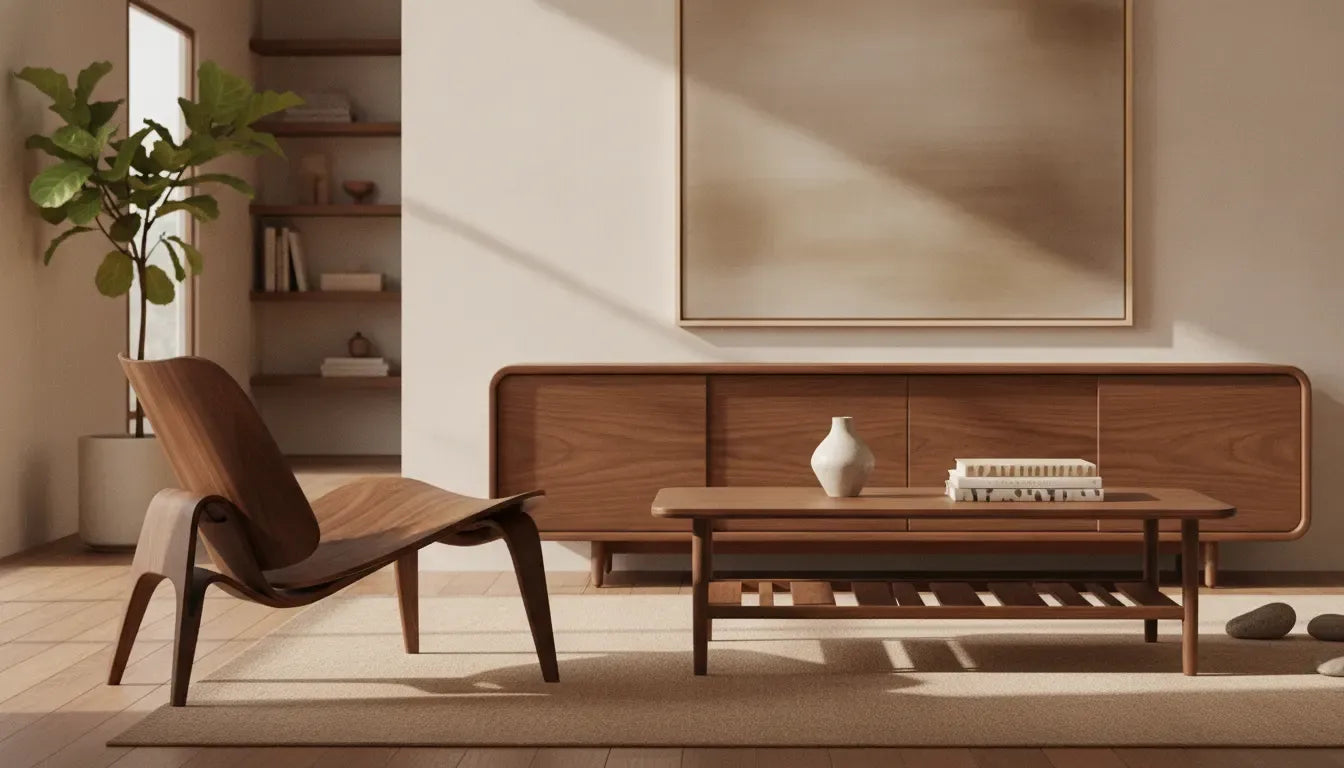

Walnut furniture has a way of making a room feel considered without making it feel formal. The color is warm, the grain has quiet movement, and a well-made piece can support daily life without looking disposable. But a walnut-colored surface is not the same thing as solid walnut construction. If you are comparing pieces for a living room, the important questions are about the material beneath the finish, the way the parts are joined, how the design handles natural wood movement, and whether the piece will remain useful as your home changes.
Browse Gingko Furniture's living-room collection for solid walnut seating, tables, and storage designed around lasting use.
This guide gives you a practical way to evaluate those decisions. It explains what solid walnut means, why black walnut is valued for furniture, how construction affects long-term performance, what to compare when a piece uses veneer, and how finish and care fit into the ownership experience. It also gives you a quality checklist you can use before ordering any walnut furniture, including a piece from a direct-to-consumer brand.
Solid walnut furniture uses walnut lumber in the structural parts of a piece, rather than using a walnut-colored finish or a thin walnut face over an unrelated core. A product can also combine solid walnut with other materials honestly. The useful question is not whether every component is walnut, but whether the description clearly identifies the construction.
When a product page says that a table, chair frame, cabinet, or storage piece is made from solid walnut, it should tell you which parts use solid walnut. A top, leg, frame, drawer front, or structural rail may be solid lumber, while a back panel, drawer bottom, upholstery component, or hardware element may use another appropriate material. That is normal furniture construction. What matters is that the description does not make a walnut surface sound like solid walnut throughout.
Solid lumber is milled from a piece of wood. Its grain continues through the thickness of the part, subject to the shape and cut of the board. That gives the piece a visible relationship between its face, edge, and end grain. It also means the maker must design for the fact that wood responds to its environment. Solid wood is not a frozen material. It remains responsive to moisture in the surrounding air.
Veneer is a thin layer of real walnut applied to a substrate such as plywood, medium-density fiberboard, or particleboard. It can be a thoughtful choice. Veneer makes it possible to create broad, stable panels and use a log efficiently. It can also produce an attractive, consistent surface when the construction is disclosed clearly.
The distinction matters because solid walnut and walnut veneer offer different repair, refinishing, movement, and service considerations. A veneered panel may be more dimensionally stable in a particular application. A solid component may offer more material depth for future refinishing, depending on its finish and construction. Neither label answers every quality question on its own.
For a detailed side-by-side explanation, read Gingko's solid walnut versus veneer comparison. This pillar focuses on the wider buying decision: how material, joinery, finish, and everyday use work together.
Trustworthy furniture descriptions use specific nouns. They name the wood species, identify the parts made from that wood, describe the finish when relevant, and explain the joinery or frame construction when those details are central to the product. Vague phrases such as walnut look, walnut finish, or wood-style can describe appearance without telling you what you are buying.
That does not mean a product page needs a woodworking textbook. It does mean you should be able to answer four basic questions before you purchase:
If the answer is not on the page, ask the brand. A clear answer is part of the product's value.
Walnut is a strong furniture wood because it combines a recognizable color range, expressive grain, useful stiffness and hardness, good workability, and stability in use. American black walnut is especially valued for furniture and cabinets. Its natural variation gives each piece character, while its warm appearance works across modern interiors.
American black walnut is usually associated with a range of brown tones, from lighter warm brown to deeper chocolate shades. The heartwood and sapwood can differ in color, and the grain can be straight or show more movement depending on the board. That variation is not a manufacturing flaw. It is evidence that the piece is made from a natural material rather than printed to look uniform.
The USDA Forest Service describes black walnut as heavy, hard, strong, stiff, and stable in use. It also notes that the species is easily worked with tools and well suited to natural finishes. Those characteristics explain why black walnut has a long history in furniture, cabinets, interior woodwork, and decorative panels. They also explain why the material can carry a room visually without relying on heavy ornament.
You can read the underlying species information in the USDA Forest Service Wood Handbook. The source is useful because it treats wood as a material with measurable properties and trade-offs, not as a marketing category.
Walnut is often associated with mid-century modern furniture, but its usefulness is broader. Clean-lined walnut can support a Scandinavian room where the grain adds warmth to an otherwise light palette. It can soften a modern room built around stone, metal, or glass. In a Japandi interior, its depth can balance pale walls, woven textures, and restrained forms. In a more collected room, a walnut cabinet or coffee table can connect different periods without competing with them.
The common thread is proportion. Walnut does not need excessive detailing to make an impression. A tapered leg, a restrained edge, a curved back, or a quiet panel can show the material without turning the piece into a display object. Gingko's design philosophy follows this approach: clean lines, functional beauty, and natural walnut grain are allowed to do the visual work.
Two walnut pieces should not be expected to match like painted objects. Board selection, grain direction, light exposure, and the relationship between adjacent boards all affect the finished appearance. A natural finish may make those differences more visible. A darker finish may reduce some variation while still allowing the grain to show through.
Ask how the maker treats natural variation. A good answer describes it as part of the material and explains what the customer can expect. Be cautious of language that promises a perfectly uniform color or an identical grain pattern across every piece. Uniformity may be attractive in some settings, but it is not the only sign of quality.
Material quality and construction quality are connected, but they are not the same. A fine species can be used in a weak design, while a carefully engineered piece can perform well with more than one material. Evaluate the joint, the load, the grain direction, the finish, and the way the design allows solid wood to move as conditions change.
Furniture is not a slab of wood. It is a system of legs, rails, frames, panels, drawers, doors, supports, and surfaces that must carry loads and tolerate movement. Joinery is the way those parts connect. The right joint depends on the direction of the grain, the forces at the connection, the size of the part, and whether the joint needs to allow movement.
Mortise-and-tenon joinery connects a projecting tenon to a matching mortise. The joint can create a broad mechanical connection between parts when it is sized and fitted appropriately. Dovetail joinery uses interlocking shapes, often in drawers or casework, where resistance to being pulled apart is important. Other joints, fasteners, and adhesives can also be appropriate when the design calls for them. The label matters less than whether the joint is suitable for the job and executed consistently.
Gingko identifies traditional mortise-and-tenon and dovetail construction as part of its craftsmanship approach. Because construction details must be verified for the specific product, use the product page or ask the team when you are evaluating a particular chair, table, or storage piece. A general brand statement should not be treated as proof that every detail applies to every SKU.
Wood gains and loses moisture as relative humidity changes. In humid air, it takes on moisture and swells. In dry air, it releases moisture and shrinks. A finish can slow the rate of that change, but it cannot eliminate the material's response. This is normal behavior, not evidence that solid wood is defective.
The construction question is whether the designer planned for movement. A broad solid panel needs room to expand across its grain. A frame that locks it in place on all sides can create stress. A thoughtful design may use floating panels, elongated fastener holes, suitable gaps, or other methods that let the panel move without forcing the whole piece out of alignment.
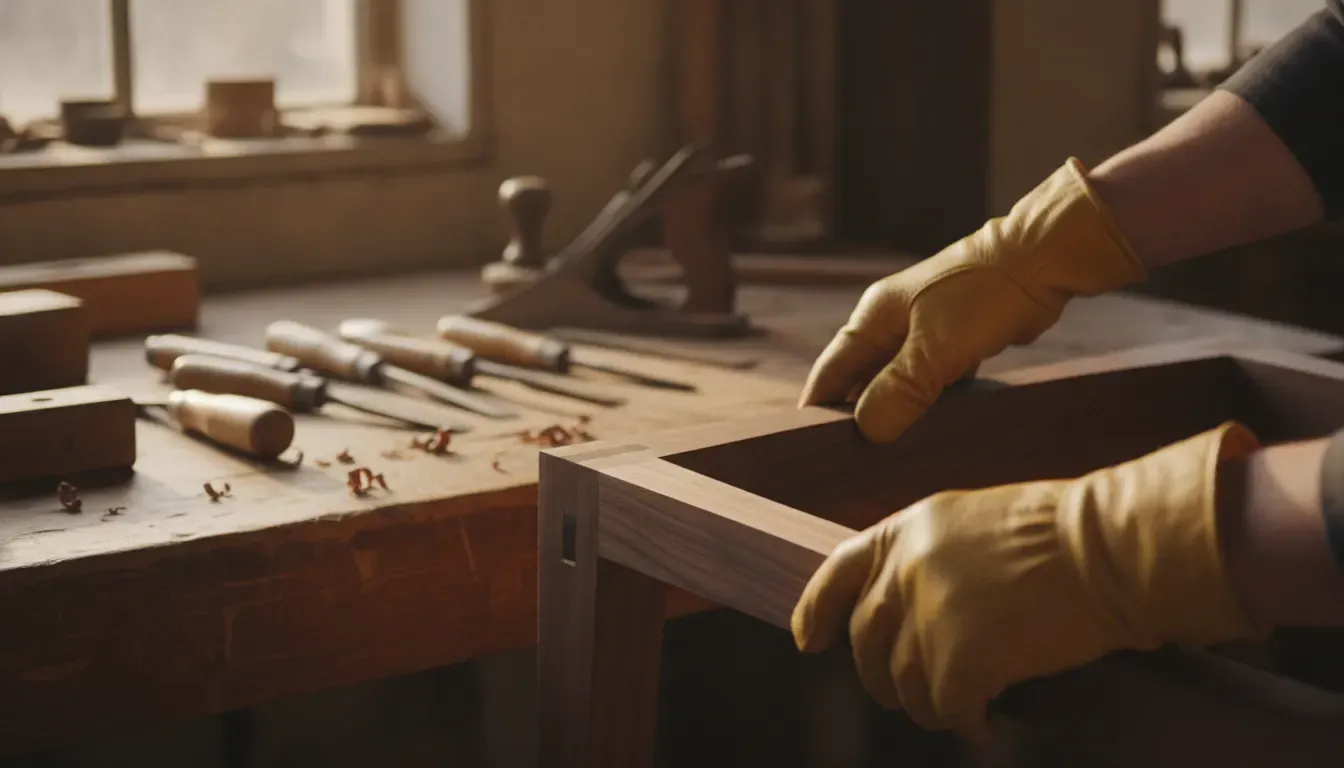
Purdue University Extension explains that furniture should allow wood to expand and contract across the grain. Wood Magazine makes the same point in practical terms: wood moves, it keeps moving, and attempts to constrain it can cause problems. These principles are why construction deserves as much attention as the species name.
Look for evidence that the maker understands movement rather than promising that the piece will never change. A slight seasonal shift in a solid wood part can be normal. Splits, binding doors, loose joints, or large unexplained gaps may point to a design, conditioning, environment, or maintenance problem. Those symptoms need a product-specific evaluation rather than a generic conclusion about all solid wood furniture.
When a listing gives only broad material language, ask for the construction story. You do not need to use technical vocabulary. You can ask:
The quality of the answer matters. A brand that can explain the construction in clear language is easier to trust than one that relies only on words such as premium, heirloom, or artisan.
Solid walnut and walnut veneer are not interchangeable descriptions. Solid walnut uses walnut lumber in the named part. Walnut veneer uses a real walnut surface over a substrate. Compare them by the intended use, the construction of the complete piece, the finish, the repair expectations, and the honesty of the product description rather than treating one label as an automatic verdict.
| Question | Solid walnut | Walnut veneer | What to ask |
|---|---|---|---|
| What is the surface? | Walnut lumber through the thickness of the part | Thin walnut face over a substrate | Which panels or parts use each method? |
| How does it respond? | Moves with moisture and grain direction | Often offers a stable panel surface | How does the design manage edges and movement? |
| What is the repair question? | More material may be available for future refinishing, depending on finish and condition | Refinishing depth is limited by the face layer | What repairs does the maker recommend? |
| What defines value? | Material depth, construction, joint quality, finish, and use | Panel engineering, surface quality, construction, finish, and use | Is the description specific and complete? |
Veneer can be a sensible choice for a wide panel. It can reduce the risk of some panel movement and make efficient use of high-quality walnut. A well-made veneered cabinet is not automatically inferior to a poorly made solid-wood cabinet. The issue is whether the construction suits the part and whether the customer understands it.
Solid walnut is appealing when you want the depth and service possibilities of solid lumber in a frame, leg, top, or other structural part. Veneer may make sense when panel stability, efficient material use, or a particular casework design is the priority. The right comparison depends on the specific furniture, not on a slogan.
On any product page, look for terms such as solid walnut, walnut veneer, plywood, engineered wood, or MDF. If the description says only walnut without explaining the construction, request clarification. For the detailed identification questions, keep Gingko's solid walnut versus veneer guide as a companion resource.
Finish is the working surface between walnut furniture and everyday life. It affects how the grain looks, how spills are handled, and what maintenance is appropriate. A valuable finish is not simply glossy or matte. It is clearly described, suited to the use, and supported by care instructions that a homeowner can follow.
Walnut can be finished in different ways, and the choice changes the visual and tactile experience. Some finishes leave more of the grain's depth visible. Others create a more uniform or more resistant surface. The important point is that the finish should match the job. A frequently used coffee table has different demands from a lightly handled display cabinet or an upholstered chair frame.
Ask whether the finish is a named product or finish type, whether it is intended for indoor furniture, and how the owner should respond to water, heat, or abrasion. A clear answer helps you make a realistic decision. It also gives you a better chance of avoiding a cleaning product that reacts badly with the surface.
Solid walnut furniture does not need to be treated as fragile, but it should not be treated as inert. Keep it away from prolonged direct heat and intense sunlight when the design or finish calls for that precaution. Use coasters or mats where they make sense. Wipe spills with a soft, slightly damp cloth rather than allowing moisture to sit on the surface. Avoid aggressive abrasives and unverified household chemicals.
Humidity matters because wood responds to the air around it. The goal is not to stop every seasonal change. The goal is to avoid extreme, rapid conditions and to give the piece a stable indoor environment. If a brand provides product-specific care instructions, follow those instructions first. A general guide cannot replace the finish maker's requirements.
Gingko's existing solid-wood FAQ is a useful related read for shoppers thinking about material responsibility. This article keeps its focus on quality and ownership. Longevity can reduce the need for replacement, but it should not be presented as an unsupported certification or sustainability claim.
Good care guidance tells you what to do and what to avoid. It does not imply that a finish makes the furniture immune to moisture, sunlight, or impact. It also does not use vague language to shift every possible problem to the owner. When product information includes clear care boundaries, you can judge whether the piece suits your routine.
That is especially important for living-room furniture. A coffee table may encounter drinks, books, keys, and sunlight. A chair frame may be touched often but not used as a work surface. A storage cabinet may need protection at its top while its doors and pulls receive repeated handling. Material and finish decisions should follow the use case.
Solid walnut furniture can be worth the investment when its material, construction, finish, proportions, and intended use all support the way you live. The value is not only the purchase amount. It is the combination of daily performance, transparent construction, repair possibilities, design longevity, and confidence that the piece will remain useful.
Price is visible, but it is not the complete value equation. A lower-priced piece may be appropriate for a temporary need, a low-use room, or a design experiment. A more carefully constructed piece may be the better choice when you want a focal item that you will use every day and keep through several moves or room changes. The correct answer depends on the furniture's role.
Start with the use. Will people sit in the chair every day? Will a cabinet carry meaningful weight? Will a table receive repeated contact with objects, food, or drinks? Will the piece need to work in more than one room over time? These questions tell you how much construction detail deserves attention.
Photography is useful for judging proportion and style, but it can hide construction. Compare candidates using the same framework:
This framework prevents a common mistake: comparing a photograph, a material word, and a price while ignoring what the piece must do for years of ordinary use. It also leaves room for honest trade-offs. A veneered panel may solve a particular design problem. A solid component may offer another benefit. Quality comes from the complete solution.
A piece does not need to look traditional to last. It needs a proportion, material, and function that can remain relevant when the room changes around it. Gingko's approach combines mid-century modern, Scandinavian, modern, and Japandi influences with clean lines and functional beauty. That gives walnut furniture a clear visual identity without tying it to a single short-lived trend.
Natural walnut also adapts. It can sit beside light upholstery, painted walls, stone, metal, woven materials, or other wood species. A good living-room piece can become an anchor while smaller accessories change. That flexibility is part of long-term value because it gives the furniture more than one possible future.
Compare walnut living-room pieces from Gingko Furniture using the material, construction, finish, and fit checklist before you choose.
Before buying walnut furniture, verify the material, construction, finish, dimensions, and care requirements. A good product page should answer most of these questions directly. If it does not, ask the brand for specifics. Clear answers reduce uncertainty and help you compare furniture on substance rather than photography alone.
For a lounge chair, focus on the frame, joints, upholstery information, seat height, and the relationship between the chair's visual weight and the rest of the room. Gingko's accent-chair collection is a useful place to compare walnut-framed seating options.
For a coffee table, focus on the top, edge treatment, base connection, finish, and distance from the sofa. A table that looks light in a photograph may have a substantial presence in a small room. Review the current coffee-table collection alongside your measurements and walking paths.
For a cabinet or media piece, inspect the door and drawer alignment, interior construction, hardware, ventilation needs where relevant, and how the case meets its base. The storage collection can help you compare the role of walnut in casework and living-room organization.
For any item, do not assume that a general brand claim answers a product-specific question. Ask for the exact detail you need, especially when a feature affects fit, care, or structural expectations.
Gingko Furniture positions its collection around hand-crafted solid walnut furniture, traditional craftsmanship, clean lines, and functional beauty. Its stated model is designed in California and built in Asia. The brand is online-first and nationwide, so shoppers can evaluate the current product information and request guidance without treating an inactive showroom as part of the buying journey.
Gingko's design philosophy lets natural walnut grain contribute the visual character of each piece. Mid-century modern, Scandinavian, modern, and Japandi influences appear through proportion, restraint, and practical use rather than decorative excess. That makes the furniture suitable for shoppers who want a room to feel warm and distinctive without becoming visually crowded.
The brand also describes traditional mortise-and-tenon and dovetail methods as part of its craftsmanship approach. Product-level details should still be checked on the page for the exact piece you are considering. That distinction is important because responsible furniture buying depends on what a specific item is made from and how that item is built.
Availability, prices, delivery timelines, shipping charges, promotions, warranty terms, and return terms can change. Check the current product and policy pages before relying on any of them. The same care applies to materials and finish: if you need a construction detail for a purchase decision, ask Gingko to confirm it for that product.
Explore Gingko's current walnut living-room collection, then contact the team for product guidance when a material, finish, or fit question remains.
Solid walnut furniture uses walnut lumber in the structural part being described. It is different from walnut veneer, which uses a real walnut surface over a substrate. A piece may use more than one material honestly, so ask which parts are solid walnut and where other materials appear.
Yes, walnut is well suited to furniture when the design and construction match the intended use. American black walnut is valued for its warm color range, grain, workability, strength, stiffness, and stability in use. The species is important, but joinery, finish, and movement planning matter just as much.
Solid walnut is walnut lumber through the thickness of the named part. Walnut veneer is a thin walnut face attached to another panel material. Veneer can be a legitimate and useful construction method. Compare the complete design, disclosure, repair expectations, finish, and intended use rather than treating veneer as an automatic sign of poor quality.
Start with three areas: construction, joinery, and finish. Confirm which parts are solid walnut, learn how load-bearing parts are joined, and look for care instructions that match the finish. Then check proportions, dimensions, movement planning, and whether the brand gives specific answers instead of only broad quality adjectives.
Solid wood responds to moisture in the surrounding air. It swells when conditions are more humid and shrinks when conditions are drier. Good furniture design allows for this movement across the grain. Extreme conditions, improper conditioning, or construction that restrains movement can create problems, so follow the product's care guidance.
It can be worth it when the material, construction, finish, fit, and intended use justify the choice. Evaluate daily performance and transparency rather than relying on price or photography alone. A piece that supports your room, routine, and future layouts can offer meaningful long-term value without needing an exaggerated promise of permanence.
Good walnut furniture is not defined by a dark color or a premium-sounding label. It is defined by a clear material story, construction suited to the job, joints that respect the way wood works, a finish you can live with, and proportions that fit your room. Those details make the purchase easier to evaluate and the ownership experience easier to understand.
Start with the questions in this guide. Confirm the exact product details, compare construction rather than photographs alone, and choose a piece whose material and design make sense for how you live. When the answer is solid, walnut furniture can bring warmth, structure, and lasting character to a living room without chasing the next trend.