

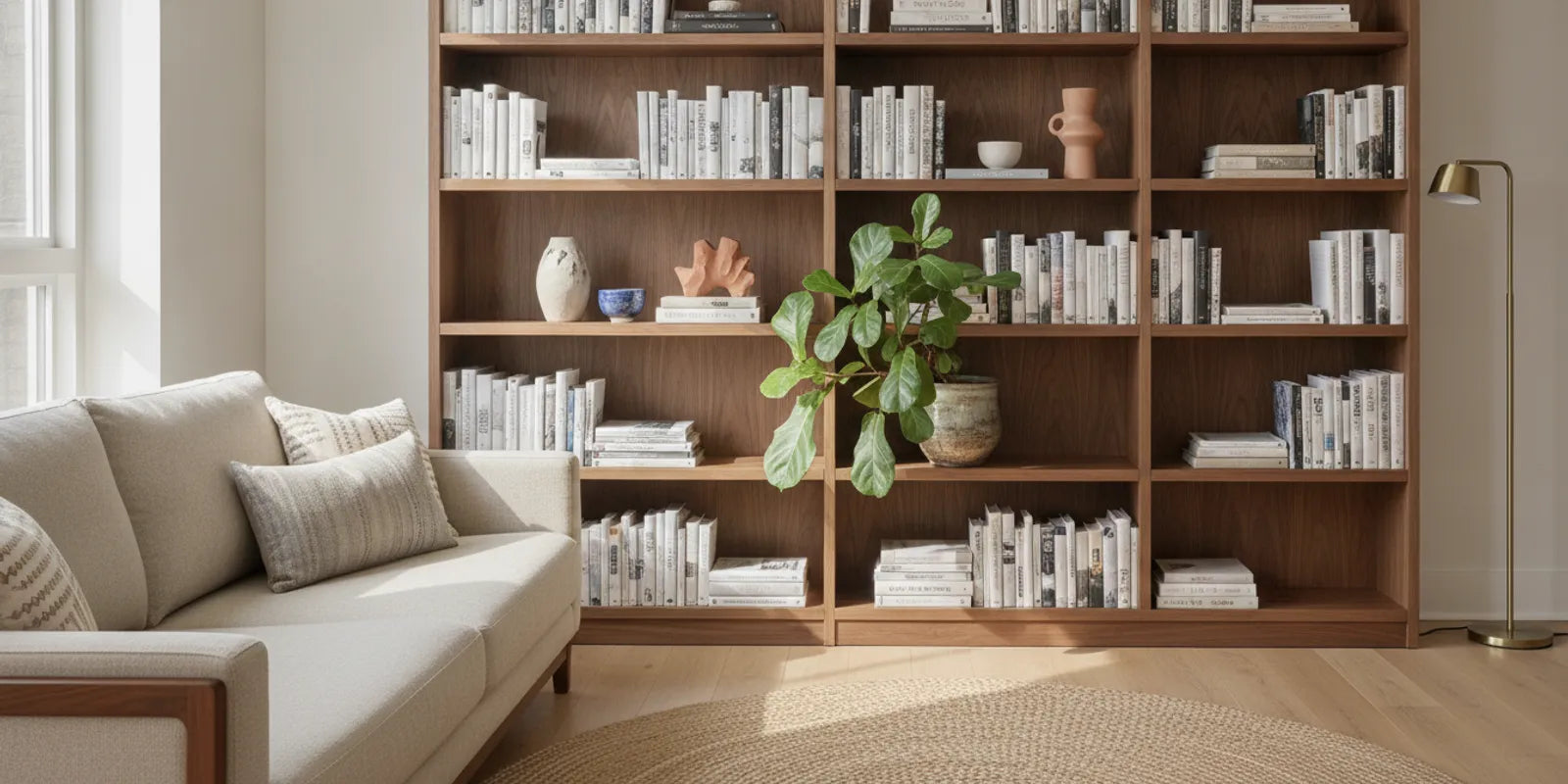

A modern bookcase can bring order to a room, display the things you care about, and add a strong architectural line without making the space feel crowded. The right choice depends on more than style: measure the room, consider what the shelves need to hold, and think about how the piece will relate to nearby furniture. This guide walks through those decisions in a clear order, so you can choose shelving that fits both your home and your everyday routines.
Ask Gingko about bookcase options
Begin with the job you want the bookcase to perform. A shelf for a small reading corner has different requirements from a full wall of books or a display piece in an open living room. A clear purpose keeps the decision grounded and helps you avoid choosing by appearance alone.
List what belongs on the shelves now and what may join the collection later. That could mean hardcovers, paperbacks, framed photographs, ceramics, baskets, records, or a mix. Consider whether you want most objects visible or whether some should sit behind doors. Open shelving makes a collection easy to scan and gives a room an airy quality, while enclosed sections quiet visual clutter and protect selected belongings from dust.
Then look at the room around the bookcase. Is it meant to anchor a blank wall, sit beside a sofa, mark the edge of a work area, or fill an alcove? The role affects the ideal height and width. A taller, narrower piece draws the eye upward; a low, wide bookcase can create a horizontal line that feels settled and can support display objects. For more inspiration across the room, browse Gingko's mid-century living room furniture.
Measure the available width, height, and depth before comparing pieces. Measure the wall itself, then note baseboards, door trim, outlets, vents, window sills, and nearby furniture. A bookcase may technically fit the wall yet interfere with a door swing or make a narrow passage uncomfortable. Leave enough space to walk by and to reach shelves without twisting around another piece.
Measure ceiling height in the exact spot where the bookcase will stand. Floors and ceilings are not always perfectly level, especially in older homes. If you are considering a tall design, allow room to position it safely and account for any crown molding or sloped ceiling. For an alcove, measure the width near the floor, at shelf height, and near the top. Small differences can affect whether the sides will sit cleanly against the wall.
Depth deserves its own check. A deeper shelf can hold larger books and baskets, but it projects farther into a room and may make a compact walkway feel tight. A shallow bookcase has a lighter profile, although oversized books may extend past the shelf. Measure a few of the largest items in your collection rather than estimating from the average. For display objects, measure the largest vase or framed piece too.
Keep a simple record of your measurements and compare them with the product's listed overall dimensions, not just a shelf's usable area. If a page gives shelf spacing or interior dimensions, check those separately. When that information is not clear, ask the retailer to confirm it before deciding. Gingko's bookcase and bookshelf collection is a relevant place to compare silhouettes and configurations.
There is no single ideal bookcase size. The useful dimensions are the ones that suit the wall, the objects, and the way people move through the room. Use this comparison as a planning tool, then confirm the exact measurements for each piece you consider.
| Configuration | Where it can work well | What to check | Visual effect |
|---|---|---|---|
| Tall and narrow | A compact wall, reading nook, or area with limited floor width | Ceiling clearance, stability, shelf height, and access to upper shelves | Draws the eye upward while leaving more floor area open |
| Low and wide | Below a window, along a long wall, or behind a sofa when the room permits | Window trim, walkway clearance, and whether the top will become a display surface | Creates a calm horizontal line and can feel visually grounded |
| Medium-height, open shelving | A living room or shared space where objects should remain visible | Book depth, shelf spacing, and how the open contents will look together | Keeps the room feeling open, with the collection on view |
| Mixed open and enclosed storage | A room with books and smaller items that benefit from a quieter appearance | Door clearance, access, and the balance between display and concealed storage | Combines a display area with a more composed visual field |
A measurement plan also benefits from a paper or painter's-tape outline. Mark the proposed width and depth on the floor, then stand back from the main entrances to the room. This makes it easier to notice if a piece will dominate the view, obstruct a route, or crowd a chair. If the bookcase will be close to a sofa or table, mark those outlines too. The goal is not to fill every inch of the wall; it is to leave enough breathing room for each piece to read clearly.
Book dimensions vary. A row of paperbacks needs less vertical room than large art books, and storage boxes or records may require greater depth than novels. Sort the collection into rough groups and measure representative items from each. For each group, note the tallest item, widest cover, and approximate depth. This small exercise can prevent a shelf layout that looks generous in a photograph but does not fit what you own.
Check both the distance between shelves and whether that spacing can change. Fixed spacing can create a clean, consistent rhythm, but it may not suit tall books or occasional display objects. Adjustable shelves allow more flexibility when the collection changes, as long as the adjustment system is secure and the shelf remains supported at the intended span. The product listing should clarify which arrangement is possible; do not assume that a shelf can be repositioned.
Also consider how far books sit back from the front edge. A deeper shelf can accommodate large volumes and a second row in some circumstances, but stacking books in front of one another makes titles harder to find and can make the display feel dense. For an orderly look, leave some open shelf area rather than filling every gap. A few horizontal stacks can vary the arrangement, but keep the items easy to remove without moving a whole group.
If the room needs a lighter touch than a full bookcase, compare a smaller display shelf or a wall-mounted option. Gingko's large wall shelf and small wall shelf offer a different scale for selected books and objects. Confirm each item's dimensions and mounting requirements before planning its position.
Related products


These sleek wall shelves add a modern architectural touch to any space.
View productA bookcase should feel steady in its intended location and suit the items it will carry. Look for clear product information about materials, construction, shelf support, and assembly. The listing should explain whether the piece arrives assembled or requires setup. Follow the manufacturer's assembly instructions exactly; a connection left loose can affect how the bookcase stands.
Consider the relationship between height, depth, and the weight placed on the shelves. A tall, shallow piece with heavy objects high up needs particular attention to stability. Check whether the manufacturer provides an anti-tip device or recommends securing the bookcase to a wall. If so, follow the instructions and confirm that the fastener is appropriate for the wall type. In a home with children or pets, anchoring tall furniture is a practical safety measure, not merely a finishing detail.
Look at how each shelf is supported. Shelves that span a long distance may respond differently under a heavy load than short shelves with a center support. Check any published weight guidance and do not exceed it. If a product page does not provide enough detail for your needs, ask for clarification before ordering. Avoid assuming that two bookcases with similar outlines have the same construction or load capacity.
Material affects both appearance and the character of the room. Solid wood shows natural grain variation, while other materials and finishes can create a more uniform surface or a different price point. Gingko describes its furniture as handcrafted solid walnut, with mid-century modern and contemporary design influences. To compare the brand's material approach with a specific bookcase, review the Gingko Furniture story and the details on the individual product page. Construction information should always be confirmed for the specific piece rather than assumed from a general style description.
Open shelves can make books and collected objects part of the room's character. They also show everything at once, so an unplanned mix can look busy. A simple arrangement helps: group books by broad category or size, leave a few open spaces, and place a limited number of objects between groups. The aim is a display that feels collected rather than crowded.
Think about practical access. Everyday reading material belongs at a comfortable height, while objects you rarely reach for can occupy a higher shelf. Heavier books are generally easier to retrieve from lower shelves than from overhead. Keep fragile objects away from the edge and avoid piling so much on one shelf that it becomes difficult to lift or sort items.
Enclosed storage can balance an open display. It gives small items a home without asking every object to contribute to the room's visual arrangement. If you want that combination, explore Gingko's solid-wood storage collection or its cabinet collection as complementary options. A bookcase and a cabinet do not need to match exactly; shared material, proportion, or finish can create a connection while letting each piece serve a different role.
Before filling the shelves, consider the colors and shapes already in the room. Repeating one or two tones from a rug, artwork, or nearby furniture can help the bookcase feel integrated. Leave variation in the display as well. A row of identical objects may look overly formal, while a mix of every color and scale can feel unsettled. A measured combination of books, framed work, and a few sculptural pieces often gives the eye places to rest.
Visual balance is about how the bookcase relates to the room, not about matching every object. A tall piece has visual weight, particularly when it sits beside a low sofa or across from a large window. You can balance that height with artwork, a floor lamp, or another vertical element elsewhere in the room. A wide, low bookcase may need a larger framed piece above it or a carefully edited display on its top surface.
Consider the outline of the bookcase as well as its color. Clean lines can sit comfortably beside furniture with similarly restrained forms, while a piece with a pronounced frame can become a focal point. Wood grain adds movement and warmth, so it may pair naturally with quieter textiles or painted walls. Avoid trying to coordinate every wood tone exactly. Instead, look for compatible undertones and repeat a finish or material in a smaller detail elsewhere.
Negative space matters. Leaving wall visible around a bookcase can make it feel intentional rather than squeezed into place. On a large wall, one modest piece may look isolated; a larger arrangement or the addition of a lamp and chair can establish a reading zone. In a small room, a tall open design may preserve more visual openness than a wide, solid block. These are useful starting points, not rules: compare the view from the doorway and the places where you spend the most time.
Choose a location with enough clearance for people to pass, pull out books, and open any doors. Keep the bookcase away from areas where a door, cabinet, or drawer could strike it. In a reading corner, place it within easy reach of the chair but do not crowd the seat. In a living room, consider how the shelves appear from the sofa and whether they compete with a television or artwork.
Light and environmental conditions matter. Direct sun can alter the appearance of some materials and finishes over time, and damp areas are rarely ideal for wood furniture. Avoid blocking heating or cooling vents. If the bookcase will sit near a window, consider how curtains or blinds move and whether the window sill changes the available height. For a wall-mounted shelf, identify the wall structure and follow product-specific mounting guidance.
In an open-plan space, a bookcase can help suggest a boundary between areas, but its height and openness affect whether the room still feels connected. A low or open design preserves sightlines; a taller, more filled piece creates a stronger division. Maintain a clear path around it and think about which side will face the main gathering area. Where a display shelf is not enough, compare the broader living room collection to see how shelving might relate to seating and tables.
Before making a decision, compare the details that matter to your home rather than relying on a product photo alone. A careful check helps reveal differences between pieces that appear similar at first glance.
Finally, imagine the piece with its shelves partly filled rather than packed to capacity. This gives you a more realistic sense of its visual weight and leaves room for the collection to change. If a bookcase only works when every shelf is perfectly arranged, it may not suit a busy household. A well-chosen piece should make the room easier to live in while giving treasured books and objects a considered place.
Explore Gingko's bookshelf collection
Choose a depth that fits the largest items you plan to store while preserving comfortable circulation around the room. Measure a few large books and objects, compare their depth with the listed shelf depth, and consider whether anything will extend beyond the front edge.
Open shelving makes books and objects easy to see and reach, and it can keep a room feeling lighter. A cabinet hides smaller belongings and creates a quieter appearance. The right choice depends on whether display or concealed storage matters more; a combination can serve both needs.
Check the manufacturer's safety instructions and any supplied anchoring guidance. Tall furniture can tip, so follow the product's directions and use a suitable wall attachment when recommended. This is especially important in homes with children or pets.
Group books in a few clear categories, vary horizontal and vertical arrangements sparingly, and leave some open shelf space. Limit decorative objects to a considered selection and place everyday items where they are easy to reach.
The best modern bookcase is one that fits the wall, accommodates the collection, and feels balanced beside the furniture already in the room. Start with measurements and stability, then compare shelf layout, storage style, material, and visual proportion. With those details settled, it becomes easier to choose a piece that brings function and a composed presence to your home.