

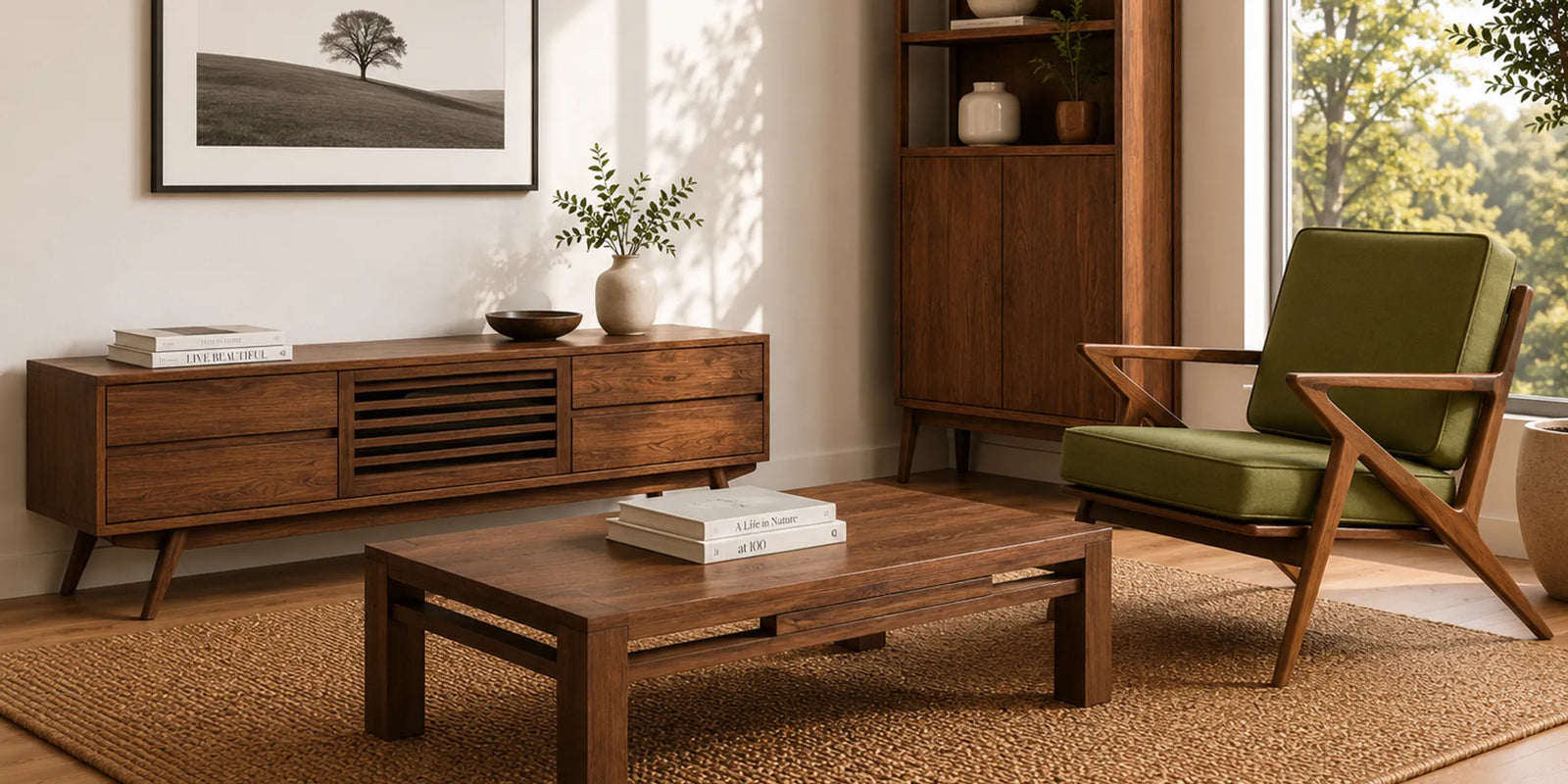

Buying furniture is not only a matter of finding a shape you like. The right piece has to fit the room, support the way you live, feel good to use, and hold up as your home changes. This furniture buying guide gives design-conscious homeowners a practical framework for choosing seating, tables, and storage with more confidence, especially when shopping online.
Explore Gingko Furniture's living-room collection for solid walnut seating, tables, and storage designed around lasting use.
Gingko Furniture approaches furniture through clean lines, function beauty, natural materials, and human-scaled proportions. The brand's mid-century modern, Scandinavian, modern, transitional, and Japandi influences make a useful case study in buying well: a piece can have a distinctive point of view without becoming difficult to live with. Use the steps below to evaluate any furniture purchase, then narrow your search to the materials and forms that suit your home.
The best furniture buying decisions begin with the room's job, not with a product photo. Decide how people will use the space, what activities need support, and which piece should anchor the arrangement. Function gives you a clear filter for size, comfort, storage, material, and style.
Before browsing, describe the room in one sentence. A living room might be a place for reading, conversation, movie nights, hosting, or a combination of all four. That answer changes what you should prioritize. A reading-focused room may need a supportive lounge chair and a table within reach. A social room needs clear conversation zones and enough surface space for drinks or books. A family room may need resilient upholstery, easy circulation, and storage that keeps daily objects contained.
Make two lists before you shop. The first is made of essentials: the seating capacity, storage function, surface area, or clearance the room cannot do without. The second is made of preferences: a particular wood tone, upholstery color, leg profile, or design era. This keeps an attractive detail from taking priority over a basic requirement.
For a mid-century modern living room, the foundation may be a sofa or lounge chair, a coffee table, and storage. You do not have to purchase every piece at once. A measured, phased approach often produces a more coherent room than filling every open spot in a single weekend.
Choose the piece that works with the room's current scale and circulation. A large home can still feel crowded when furniture is oversized, while a small room can feel unfinished when every piece is too slight. Human-scaled furniture leaves room for movement and allows the architecture, windows, and natural light to remain part of the composition.
Measure the room, the furniture footprint, and the route the piece will take from the delivery point to its final position. Record wall lengths, doors, windows, stairs, elevators, and tight turns. Then map the proposed footprint on the floor so you can test circulation before ordering.
A commonly used proportion guideline is to choose a coffee table that is about two-thirds the length of the sofa, but it is a starting point rather than a rule. The table should leave comfortable passage around it and sit in a useful relationship to the seating. The best measurement is the one that supports the room's actual traffic pattern. If you want to compare a live product example, review Gingko's Borgen round walnut coffee table alongside your room plan and available clearances.
| What to measure | Why it matters | Question to ask |
|---|---|---|
| Room and wall dimensions | Sets the furniture's visual and physical scale | Will the piece leave enough breathing room? |
| Doorways and turns | Confirms the piece can reach the room | Can it clear every tight point in its route? |
| Walking paths | Protects daily circulation | Can people move without weaving around corners? |
| Adjacent heights | Keeps the composition visually balanced | Will the new piece compete with a window, shelf, or screen? |
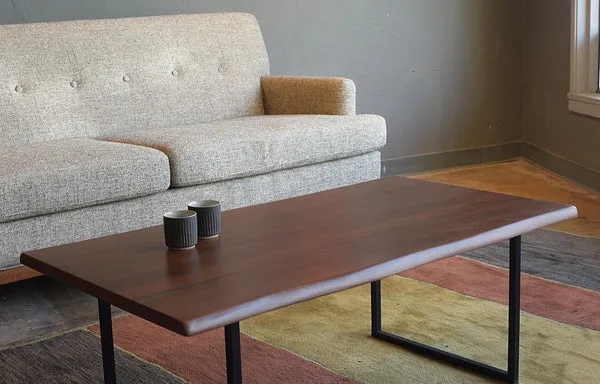
Material quality is only one part of furniture quality. Look for clear information about the wood or other primary material, the structural parts, the joinery, the finish, and the components that receive daily wear. Specific descriptions let you compare construction honestly instead of judging a piece by color or styling alone.
A walnut-colored finish does not tell you whether a piece is solid walnut, walnut veneer, another wood, or a composite substrate with a printed surface. Read the product description for the construction story. It should identify the material, explain where it is used, and avoid making a decorative surface sound like the entire structure.
Solid wood is milled from lumber, so the grain continues through the thickness of the component. Veneer is a thin layer of real wood applied to a substrate. Both can be used thoughtfully. Veneer can create stable broad panels and make efficient use of a log. Solid wood can bring a deeper material presence and may offer different repair or refinishing considerations, depending on the design and finish.
The useful question is not whether one label automatically makes a piece right for every room. Ask what the product is made from, which parts are structural, how the material responds to its environment, and whether the construction suits the intended use. For a deeper material comparison, read Gingko's guide to evaluating solid walnut furniture.
Joints connect the parts that carry load and receive movement. Mortise-and-tenon and dovetail construction are examples of traditional approaches that can be meaningful when they are used appropriately and described accurately. Fasteners and modern engineered components can also be appropriate in specific locations. The goal is not to collect technical terms. It is to understand how the piece is assembled and whether the maker treats structure as carefully as appearance.
Gingko Furniture emphasizes hand-crafted solid walnut pieces and traditional joinery, including mortise-and-tenon construction. That construction story supports the brand's focus on furniture designed for lasting use, while the clean forms keep the result appropriate for contemporary rooms.
A finish protects and shapes the appearance of wood, but it does not erase the character of the material. Walnut grain, tone, and small variations are part of the reason people choose it. Ask how the surface should be cleaned, what exposure to sunlight is appropriate, and whether the finish is intended to look uniform or allow natural variation to show.
When a seller provides care information, read it before buying. A beautiful material is easier to live with when its maintenance fits your routines. Gingko's living-room collection is a useful place to compare how walnut seating, tables, and storage are presented together.
Compare Gingko's seating collection when you are ready to evaluate comfort, upholstery, and frame design in the context of your room.
Choose seating by combining body comfort, posture, dimensions, and the way people will use the room. A chair or sofa should look balanced from across the room and feel supportive after more than a few minutes. Upholstery, seat depth, back angle, arm height, and entry clearance all deserve attention.
Product photography can make seating look comfortable while hiding details that affect everyday use. Read the dimensions and consider the posture you want. An upright chair may support conversation or reading, while a deeper lounge chair may suit relaxed evenings. Neither is universally better. The right choice depends on the room's job and the people who use it.
Texture and color influence how a room feels, but upholstery also affects care and longevity. Consider whether the fabric or leather suits the household, how much direct sunlight reaches the piece, and whether the finish you prefer works with nearby rugs, wood tones, and walls. Request current material details when the product offers options, because colors and availability can change.
For a smaller room, raised legs and a visually open frame can help preserve a sense of floor space. For a larger room, a substantial frame or a pair of chairs may create a stronger conversation zone. Use proportions to shape the room rather than assuming that one large item must fill it.
Imagine a normal hour in the room. Will someone sit upright with a book, stretch out, host several guests, or move between the seating and a nearby table? The answer can reveal whether you need a compact accent chair, a deep lounge chair, a sofa with a firmer seat, or a combination of seating types.
Gingko's accent chair collection shows how a consistent walnut frame language can be paired with different upholstery directions. Use that kind of comparison to think about both comfort and the visual role a chair will play.
Furniture works together when the room has a repeated visual language without becoming a matching set. Coordinate through proportion, material, color temperature, and one or two shared design details. Let each piece contribute a distinct function while the overall arrangement remains calm and easy to read.
Start with the largest or most important piece, then build outward. In a living room, the sofa or primary chairs usually establish the scale. A coffee table should relate to the seating without blocking movement. Storage should support the room's needs while giving the eye a place to rest.
Walnut can connect a room across several furniture types, but every surface does not need to be identical. A walnut frame, a darker wood accent, and a textured neutral upholstery can feel more collected than a room filled with one matching finish. Natural variation also keeps solid wood from looking manufactured to a single template.
Pair a substantial item with breathing room, open shelving, or a lighter silhouette. If every piece is visually heavy, the room may feel compressed. If everything is delicate, the arrangement may lack an anchor. Mid-century modern design is especially useful here because tapered legs, open bases, and restrained forms can make solid materials feel visually light.
Gingko Furniture's approach combines mid-century modern and Scandinavian influences with contemporary function. The result is a useful reminder that style is not a shopping category alone. It is a set of decisions about proportion, material, and how a piece behaves in the room.
Online furniture shopping is safest when the product page answers the same questions you would ask in a showroom. Confirm dimensions, materials, construction, upholstery, care, delivery, availability, and return information. If an important detail is unclear, ask before ordering rather than treating an attractive photograph as evidence.
Fully assembled delivery can be especially useful for shoppers who want to avoid complicated setup, but confirm that detail for the specific product and current order. When an online brand offers personal guidance, use it. A short conversation about dimensions and room function can prevent a costly mismatch.
A practical furniture buying plan moves from room function to measurements, construction, comfort, coordination, and current seller information. Buy the pieces that solve the most important problems first, then add supporting furniture as you learn how the room performs. This approach produces a more personal and durable result than impulse buying.
For a living room built around solid walnut furniture, start with the category that solves the clearest need. Browse coffee tables when the seating arrangement needs a practical center, or explore storage furniture when the room needs order without visual clutter.
Browse Gingko Furniture's living-room pieces and use your measurements, material priorities, and room plan to narrow the collection with confidence.
The most important consideration is whether the piece fits the room's function and physical constraints. Start with how you will use it, then verify dimensions, delivery access, comfort, construction, and care requirements before making a style decision.
Look for clear information about materials, structural parts, joinery, finish, and the components that receive daily wear. Specific construction details are more useful than broad quality claims. Also consider whether the design is proportioned for real use and whether the seller provides care guidance.
Solid wood is not automatically the best choice for every component or application. Veneer and engineered substrates can be appropriate when they are used honestly and suit the design. Compare the construction, intended use, stability, finish, and care requirements rather than relying on one label.
Start with the piece that solves the room's primary need, which is often the main seating or the storage that makes the room usable. Measure around that anchor before adding a coffee table, accent chair, or additional storage. A phased plan helps you preserve circulation.
Choose pieces that fit the room's actual footprint and leave clear walking paths. Open bases, raised legs, adaptable storage, and visually calm silhouettes can help a small room feel less crowded. Tape the footprint on the floor before ordering and check the delivery route.
Prioritize useful proportions, honest materials, comfortable forms, and a finish you will enjoy living with. A restrained design can stay relevant while textiles, art, and accessories change around it. Gingko's mid-century modern approach pairs clean lines with natural walnut and everyday function for that reason.