

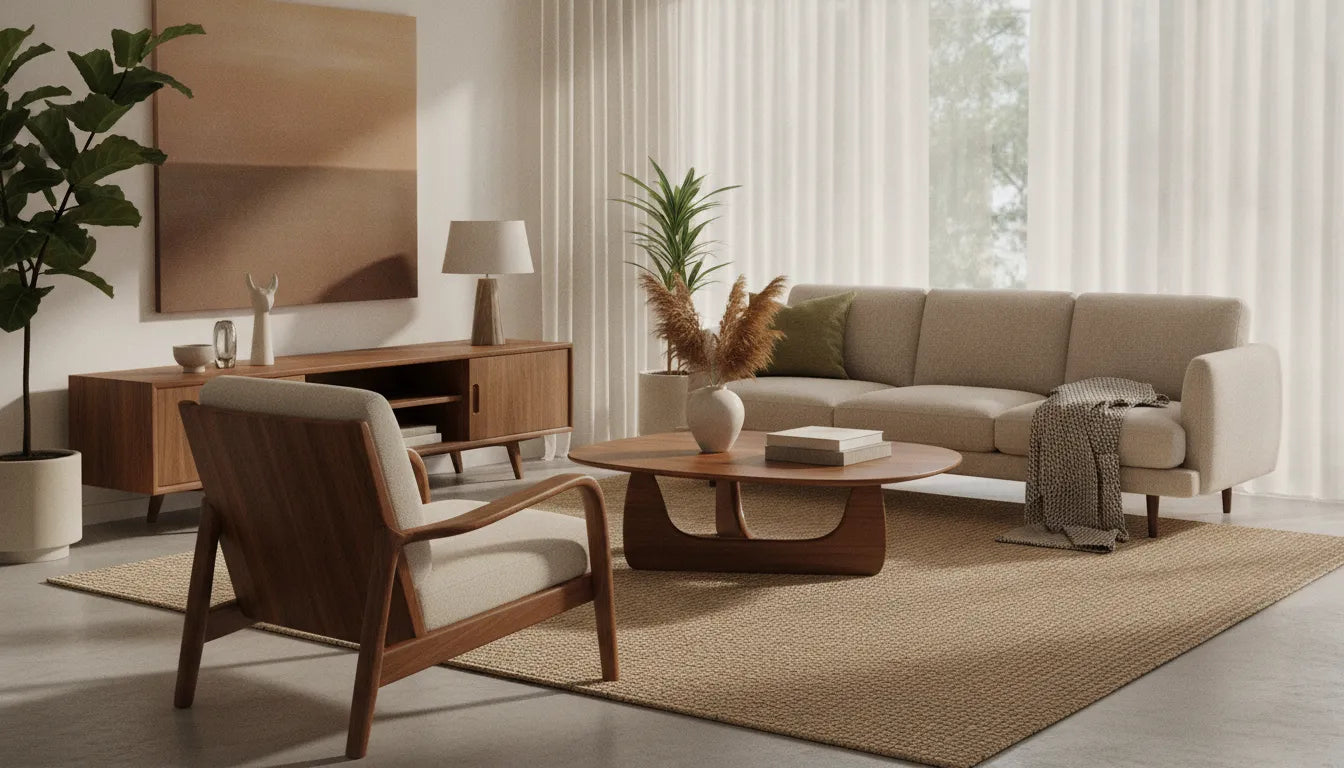

What is mid-century modern design? It is a design approach that pairs practical, human-scaled furniture with clean lines, organic shapes, honest materials, and an optimistic view of modern living. The style took shape around the middle of the 20th century, yet its balance of comfort, clarity, and warmth still feels right in today's homes.
Read Gingko Furniture's Mid-Century Modern Furniture: A Complete Style and Buying Guide for room-planning and furniture-buying guidance, then explore the mid-century modern living room collection.
Mid-century modern design is a broad design language associated with the postwar decades, especially the 1940s through the 1960s. It values function, clear structure, natural materials, purposeful proportions, and a lighter visual footprint. It is less a strict checklist than a way of making everyday objects useful, approachable, and visually calm.
The name combines two ideas. "Mid-century" points to the period when the style became widely influential. "Modern" describes its forward-looking response to new ways of living, new materials, industrial production, and changing ideas about comfort. The label can describe architecture, furniture, lighting, textiles, ceramics, and graphic design, not only a particular chair or table.
Mid-century modern is also not identical to vintage furniture. A vintage piece was made in an earlier period. A new piece can be mid-century modern in spirit when it uses the movement's principles while meeting current expectations for scale, comfort, materials, and everyday use. That distinction matters when you want the character of the style without turning your home into a period set.
Mid-century modern design did not begin in one country or with one designer. It developed through overlapping work in Europe, the United States, Scandinavia, Italy, Japan, and elsewhere after World War II. Designers responded to new homes, new technologies, mass production, and a desire for furniture that felt modern without losing comfort, craft, or a connection to nature.
European modernism and the Bauhaus helped establish the importance of function, structure, and materials. After the war, those ideas were adapted to more informal domestic life. American manufacturers and designers explored molded plywood, fiberglass, plastics, metal, and improved upholstery. Scandinavian designers brought a strong preference for natural materials and careful craftsmanship. Japanese design contributed a distinct sensitivity to proportion, restraint, and the relationship between an object and its surroundings.
California developed its own important expression of the style. Indoor-outdoor living, smaller postwar homes, relaxed entertaining, and a bright climate encouraged furniture that felt open, practical, and visually light. LACMA's overview of California Design, 1930-1965 describes how the state shaped furniture, textiles, ceramics, industrial design, and the broader material culture of the country.
Several designers are closely associated with the period, but mid-century modern design was never the work of a single design hero. Charles and Ray Eames, George Nelson, Eero Saarinen, Florence Knoll, Isamu Noguchi, Arne Jacobsen, Hans Wegner, and many other designers each developed different answers to similar questions: How should furniture support modern life? How can it be made efficiently? How can a useful object also offer beauty?
| Influence | Common contribution | What it adds to a room |
|---|---|---|
| European modernism | Functional planning and structural clarity | A sense of order and purpose |
| American design | Industrial materials and scalable production | Comfort, experimentation, and broad access |
| Scandinavian design | Natural materials and quiet craftsmanship | Warmth, simplicity, and tactile appeal |
| Japanese design | Restraint, proportion, and respect for space | Calm silhouettes and visual breathing room |
| California design | Casual living and indoor-outdoor connection | Lightness and easy, informal comfort |
SFO Museum's mid-century design overview captures the movement's practical appeal: the best objects balanced expression, efficiency, utility, and organic beauty. That combination helps explain why the style traveled so well across regions and generations.
The five defining features of mid-century modern furniture are clean lines, function-led forms, organic curves, visual lightness, and honest material expression. These qualities work together rather than appearing as isolated decorations. A piece can feel recognizably mid-century modern when its silhouette, construction, and proportions make the design easy to understand and comfortable to use.
Clean lines do not mean every edge must be sharp or every surface must be plain. They mean the main idea of the piece remains visible. A chair's arms, a table's base, or a cabinet's doors should establish a clear rhythm. When decoration competes with the silhouette, the design usually moves away from the movement's restraint.
Mid-century modern furniture treats use as a design opportunity. A low lounge chair can make reading feel relaxed. A cabinet can organize a room while keeping technology and objects visually quiet. A coffee table can create a useful surface without blocking conversation. The result is furniture that feels intentional because its appearance follows a real job.
Curves bring a human quality to the style. They can soften a chair back, make a table easier to approach, or create a more welcoming relationship between a piece and the person using it. Curves should support the overall structure, not appear as random decoration.
Many mid-century modern pieces use space beneath the seat, cabinet, or tabletop. That open area lets the floor remain visible and helps a room feel less crowded. The effect is valuable in both a compact apartment and a larger living room where furniture needs to define zones without closing them off.
The style often lets materials provide the decoration. The grain of solid walnut, the texture of upholstery, the sheen of metal, or the color of molded material can carry the visual story. Gingko Furniture applies this principle through solid walnut seating, tables, and storage, with the natural variation of the wood kept visible rather than hidden under heavy ornament.
Browse Gingko's solid walnut accent chairs to see how a clean frame, upholstery, and natural wood can work together in a contemporary room.
Related products

The Charlotte Mid Century Modern chair features a solid walnut frame carefully crafted by skilled carpenters.
View product
Mid-century modern style endures because it solves lasting household problems with adaptable forms. It makes rooms feel organized without making them formal, uses natural materials to add warmth, and gives furniture a clear purpose. The style can also absorb new colors, technologies, room sizes, and comfort expectations without losing its basic design logic.
Its visual restraint is one reason it works across changing interiors. A walnut chair can sit beside contemporary lighting. A low cabinet can support new media equipment without dictating the entire room. A simple coffee table can connect upholstered seating while leaving space for conversation. The furniture does not need every surrounding object to share the same era.
Its human scale matters just as much. Many homes now combine work, rest, dining, and entertaining in fewer rooms. Furniture that is visually lighter and easy to use can define those activities without creating hard barriers. Mid-century modern design meets that need because it treats proportion and circulation as part of beauty.
There is also a material reason for its staying power. Natural wood, leather, wool-like textures, and woven surfaces develop visual depth over time. They make a room feel grounded while still allowing the architecture and daylight to show through. For a closer look at how construction and material choices affect long-term furniture value, see Gingko's solid walnut furniture guide.
Authentic mid-century modern influence is less about a famous name or a high price than about whether the piece consistently applies the style's principles. Look at the silhouette, proportions, materials, joinery, comfort, and purpose together. A product can borrow tapered legs and a walnut color while missing the balanced construction and human-centered design that make the style work.
"Authentic" also does not have to mean untouched vintage. A new piece can be faithful to mid-century modern principles while using current upholstery, updated dimensions, and construction suited to today's homes. The useful question is whether the design has integrity from the first glance through daily use.
Gingko Furniture's approach is designed in California, built in Asia, and informed by mid-century modern, Mission Style, and Asian-inspired traditions. That combination keeps the focus on clean lines, natural walnut, practical scale, and traditional craftsmanship rather than on copying one historical object.
Build a warmer, more functional living room with Gingko's mid-century modern collection, including walnut seating, tables, and storage.
Mid-century modern refers to a design language rooted in the middle decades of the 20th century, while contemporary design describes what is being designed and used now. A contemporary room can include mid-century modern furniture, but the two terms are not interchangeable.
No. Vintage describes when a piece was made. Mid-century modern describes its design language. New furniture can use clean lines, human-scale proportions, organic curves, natural materials, and function-led forms without being an original period piece.
Walnut is a natural fit for mid-century modern furniture because its warm color and varied grain add depth to restrained forms. It is not required, however. The movement also includes other woods, upholstery, metal, molded materials, glass, and plastics.
Yes. Raised bases, open space beneath furniture, clear silhouettes, and human-scale proportions can help a small room feel less crowded. Measure the room and access route carefully, then choose pieces that support the room's purpose without blocking circulation.
Comfort depends on the relationship between seat depth, seat height, back angle, cushioning, upholstery, and frame support. A visually accurate silhouette is not enough. A well-made chair should suit the way you plan to read, relax, converse, or work.
Mid-century modern design remains relevant because it offers a clear way to make a home useful, warm, and visually composed. Its strongest ideas are not tied to one decade: let function guide form, use materials honestly, keep proportions human, and leave enough visual space for daily life. Those principles give the style staying power well beyond a trend cycle.
