

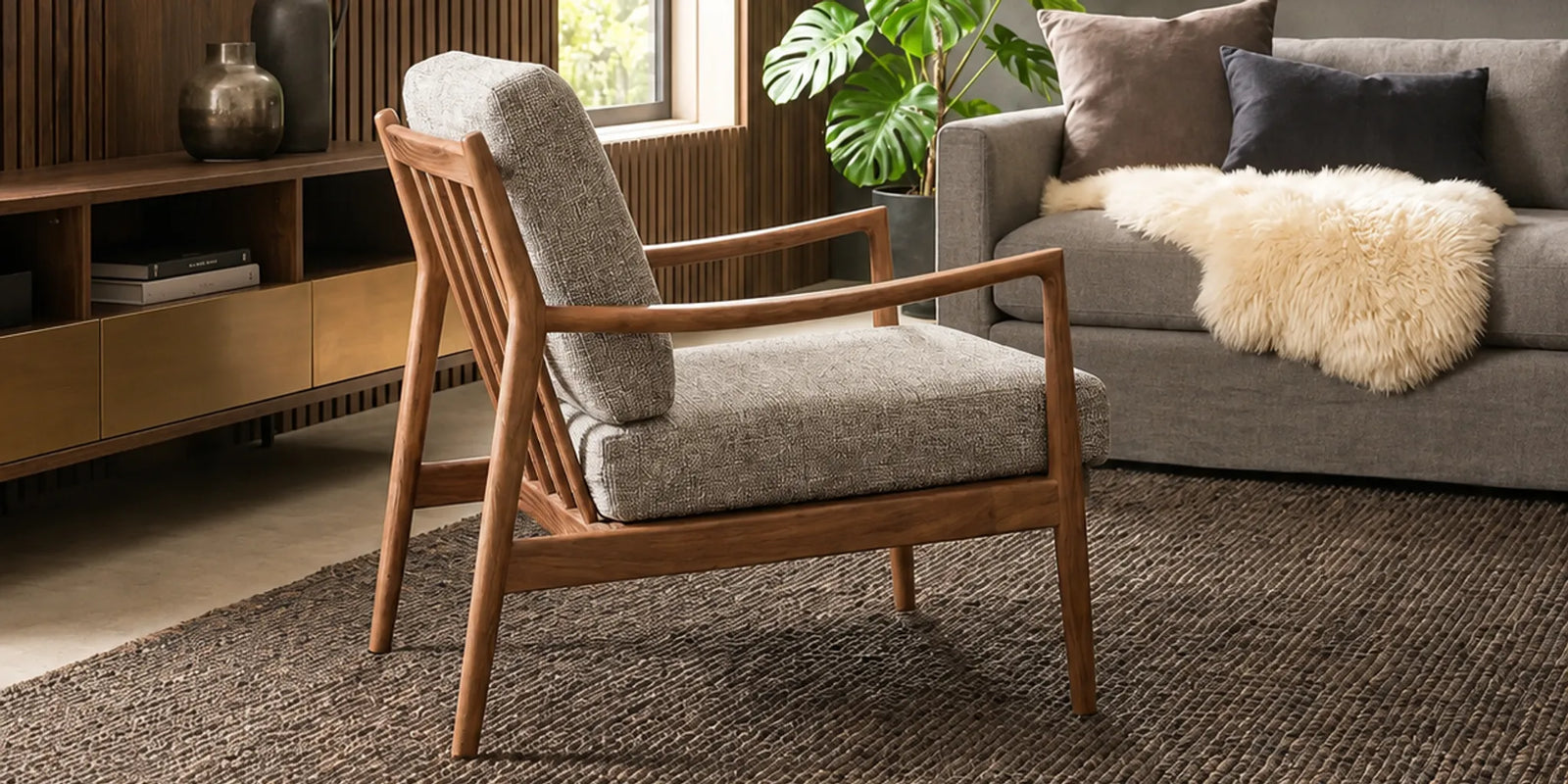

An accent chair can add character to a room without requiring a full redesign, but the right choice depends on more than a recognizable silhouette. Scale, seat height, upholstery, frame material, and the space around the chair all affect whether it feels integrated or misplaced.
Browse Gingko's accent-chair collection to compare current designs, materials, and dimensions.
To understand how to choose mid century modern accent chair options, look for clean lines, useful proportions, comfortable support, and materials that relate naturally to the rest of your room. A chair should be visually distinctive while still making everyday sitting and movement feel easy.
Mid-century modern design works especially well when classic forms meet contemporary needs. Before comparing colors or making a chair the room's focal point, it helps to identify the features that give the style its balance, function, and lasting appeal.
A mid-century modern accent chair is defined less by a single silhouette than by a clear relationship between form and use. Look for clean lines, purposeful proportions, and details that make the chair comfortable to live with rather than merely decorative. The strongest designs feel visually light, but they still have enough presence to anchor a reading corner, conversation area, or open living room.
When considering how to choose mid century modern accent chair options, begin with proportion. A chair should relate to the sofa, table, and room around it without looking oversized or lost. Human-scaled furniture can work especially well in apartments and smaller homes because it supports comfort without adding unnecessary visual bulk. That balance is central to the style's lasting appeal.
Mid-century modern design treats useful details as part of the beauty. A low, open base may help preserve a sense of spaciousness. An angled leg can contribute to stability while giving the chair a distinctive profile. A curved back may support comfort when that feature is verified for the specific design. These details should serve a purpose, not appear as decoration added after the fact.
The style also bridges classic mid-century principles with contemporary sensibilities. Its documented influences can include mid-century modern American design, Mission Style craftsmanship, and Asian design sensibility. That combination leaves room for a chair to feel recognizable without becoming a period reproduction. For a broader overview, see this guide to the mid-century modern furniture style.
Natural walnut can bring warmth and visual depth to an otherwise restrained design. Because each piece may show its own grain pattern, the wood contributes character without requiring ornate carving or excessive decoration. Upholstery, color, and shape then become practical choices that should work with the room's existing palette and the way you plan to use the chair.
The result should feel composed today and relevant beyond a single decorating trend: a chair with clean lines, functional beauty, and enough material character to remain part of the room as your style evolves.
Begin with the room, not the chair. Measure the open area where the piece will sit, then note the width and depth of nearby furniture, the location of doors, and the direction people naturally walk through the space. A chair can look beautifully scaled in a product photograph yet feel intrusive when it narrows the route between a sofa and a doorway.
Use painter's tape to mark the proposed footprint on the floor. Sit in the space for a moment and consider whether the taped area leaves a comfortable route around the chair. Check that drawers, cabinet doors, and windows can still open fully. If the chair will sit beside a sofa, compare their overall height and visual mass. A lower lounge chair may balance a substantial sofa, while a tall, broad-backed chair can compete with it.
Human-scaled proportions are especially useful in apartments and smaller rooms. Gingko describes its designs as re-scaled and simplified for contemporary urban living, with proportions intended to fit comfortably without unnecessary visual bulk. For more ideas on planning a compact room, see how to make the most of small spaces.
Seat height changes how the chair relates to the rest of the room. Compare it with the sofa, ottoman, and any table you expect to use beside it. A seat that is noticeably lower can feel relaxed and lounge-oriented. But it may not be the best choice if you want to move frequently between the chair and a dining-height surface. More important than chasing a universal measurement is testing whether your feet rest comfortably, your knees feel supported, and you can stand without awkward effort.
Product specifications can help you make a precise comparison. For example, the Zach Mid Century Lounge Chair is documented with a 17-inch seat height. Treat that as a model-specific fact, not a standard for every accent chair.
Two chairs with similar footprints can read very differently. Exposed legs and open space beneath a frame often make a piece feel lighter, while thick upholstery, arms, or a tall back add visual weight. Look at the chair from the main entrance to the room as well as from the seat itself. The strongest placement usually preserves a clear path, keeps the chair oriented toward conversation or a useful view. And leaves enough breathing room that it does not appear wedged between larger pieces.
In a small room, check the chair from several angles before committing. If it blocks light, crowds a corner, or forces other furniture out of alignment, choose a simpler silhouette or a smaller footprint. Good scale is not about making every piece match. It is about giving each piece enough room to work.
Related products


The Zach Chair is exactly where you land at the end of the day.
View product
The Charlotte Mid Century Modern chair features a solid walnut frame carefully crafted by skilled carpenters.
View productUpholstery changes more than a chair's color. It affects the way the piece feels to the touch, how much visual attention it receives, and how naturally it relates to the rest of the room. Start with the habits around the chair: Will it be used for long reading sessions, occasional conversation, or mostly as a visual accent? Then consider nearby wood tones, textiles, and light before choosing a material.
Upholstery comparison.| Upholstery | Feel and visual effect | Questions to ask | Where it may fit |
|---|---|---|---|
| Fabric | Offers a broad range of textures and colors, from quiet neutrals to a more noticeable accent. | What are the care instructions? Does the texture work with the room's existing rugs, curtains, and pillows? | Living rooms, bedrooms, and reading areas where color or softness helps connect the chair to the room. |
| Leather | Creates a more tailored, structured look and can make walnut framing feel especially intentional. | How should the specific leather be cleaned and conditioned? Will its character suit the room's other materials? | Living rooms, offices, and reading corners that benefit from a defined, grounded focal point. |
| Boucle | Brings visible texture and a softer, more tactile presence to a clean-lined silhouette. | How should the particular fabric be cared for? Will its texture balance or compete with other patterned surfaces? | Living rooms, bedrooms, and calm conversation areas where texture can add interest without changing the chair's shape. |
These categories are starting points, not guarantees about every upholstery specification. Ask for the care guidance and exact material details for the chair you are considering. Gingko's documented accent-chair examples include mineral boucle, Azure Blue, Olive Green, Picante, and black leather, although current selections and availability can change. Review the current accent-chair collection rather than assuming an example remains offered.
Color deserves the same practical attention as material. A saturated fabric can make a chair the room's focal point. While a neutral fabric or leather may let the walnut frame and surrounding furniture carry more of the composition. If the room already has several strong patterns, a quieter upholstery can provide balance. If the furnishings are restrained, boucle texture or a considered color can add dimension without relying on ornate details.
For a cohesive choice, look at the complete combination: upholstery, frame, seat proportions, and the light in the intended location. The best answer to how to choose mid century modern accent chair is not simply the most fashionable material. It is the option whose feel, care requirements, and visual weight make sense for how your home is actually used.
The frame is more than the part hidden beneath the upholstery. It influences the chair's visual character, the way it relates to other wood tones in the room, and the construction questions worth asking before you buy. In a mid-century modern setting, a visible wood frame can keep an upholstered chair from feeling visually heavy while adding warmth and definition.
Solid walnut is valued for both its material presence and its natural variation. Each piece can show a different grain pattern, so the finished chair has an individual character rather than a perfectly uniform surface. Walnut also works naturally with the clean lines and functional beauty associated with Gingko's design philosophy. To learn more about the material's background and appeal, choose quality walnut furniture with an eye toward grain, finish, and long-term use.
Ask how the frame is assembled, not just what wood it uses. Mortise-and-tenon joinery connects a projecting tenon to a matching opening in another piece of wood. Dovetail construction is another traditional method that creates an interlocking connection. These terms do not replace a hands-on comfort test or a review of the product's specifications. But they give you a more useful basis for evaluating craftsmanship than a vague claim about quality.
Construction details are not automatically shared across an entire collection. Confirm the specifications for the exact model you are considering, including the frame material, suspension, dimensions, and seat height. A chair may look similar to another model while differing meaningfully in how it is built or how it feels to sit in.
Gingko's Zach Mid Century Lounge Chair is documented with a solid walnut frame, 26 mortise-and-tenon joints, Pirelli webbing suspension, and a 16-inch seat height. Those details help a shopper understand what to investigate: the visible material, the joinery, the support system, and the relationship between seat height and nearby furniture. They describe the Zach specifically, however, and should not be generalized to every Gingko accent chair.
When comparing options, look for a frame and construction approach that suit your room. Your preferred level of visual warmth, and the way you plan to use the chair every day.
Placement determines whether an accent chair feels like an intentional part of the room or an object squeezed into leftover space. Begin with the room's purpose, then consider conversation, movement, light, and the furniture already nearby. A chair should support how you use the space, not simply fill an empty corner.
In a living room, angle the chair toward the sofa or main seating group so people can speak without turning their bodies awkwardly. Leave a clear path between the entry, major furniture, and frequently used doors. If the chair sits beside a sofa, keep its scale and seat height visually compatible. A low lounge chair may work beautifully with relaxed seating, while a more upright chair can provide a useful change in posture.
Place the chair near, but not directly in front of, a window when natural light is important. Avoid blocking the best view or creating a narrow passage. A small side table or lamp can make the position feel complete, but leave enough room to pull the chair out and sit down comfortably.
A bedroom chair can create a useful landing place for reading, dressing, or taking a short break. Set it near a window or lamp when the space allows, but do not let it interfere with closet doors, drawers, or the route around the bed. In a reading nook, pair the chair with a light source and a nearby surface for a book or drink. The chair's depth matters here: a generous lounge profile may be comfortable, yet too much depth can make a compact nook feel crowded.
In an entry, an accent chair can offer a convenient place to put on shoes, provided it does not narrow the path through the door. In a home office, position it outside the primary work zone for informal reading or conversation. Keep cords, cabinet doors, and desk clearance in mind. These rooms often need more practical circulation than visual drama.
Across every room, test the proposed position with painter's tape or temporarily move a similar-sized object into place. Check the sightlines, walking route, light, and relationship to nearby furniture before committing. For more ideas on using classic forms without making a room feel dated, see how to create a timeless home.
A considered purchase begins with the details that are easiest to overlook in a quick scroll. Use this checklist before you choose a chair:
If the answers align, you are no longer choosing by style label alone. You are choosing a chair that can support the room's proportions, your daily routines, and the lasting character you want from the furniture.
For a broader view of the material and construction questions, choose quality walnut furniture and then compare current options in the accent-chair collection.
Browse Gingko's accent-chair collection to compare current designs for your room.
A mid-century modern chair typically combines a clean silhouette, purposeful structure, and a balance of comfort with visual lightness. Look for clear proportions, restrained ornament, useful support, and materials that can stand on their own. A chair can draw from the style without looking like a museum piece, especially when its scale and upholstery suit the room.
Start with placement and function, then build around one visual connection. A walnut frame can relate to a coffee table or storage piece, while upholstery can echo a rug, artwork, or smaller accent. Leave enough space for movement and keep the chair's silhouette visible. The goal is a cohesive room, not a set of identical pieces.
The best chair depends on the room, the way you will use it, and the details you value. Compare dimensions, seat height, support, upholstery, frame material, construction information, and current delivery or return terms. A chair that looks appealing online may not be the right choice if it crowds a passage or does not suit the way you sit.
Yes. Its continued appeal comes from principles that remain useful: thoughtful proportion, clean lines, functional beauty, and materials with visible character. Rather than reproducing a room from one decade, use those principles with your home's architecture, routines, and existing furnishings.
Ready to compare your options? Browse Gingko's accent-chair collection to review current designs, materials, and dimensions. If you need help thinking through scale, upholstery, or placement, contact the Gingko team for product guidance before you choose.