

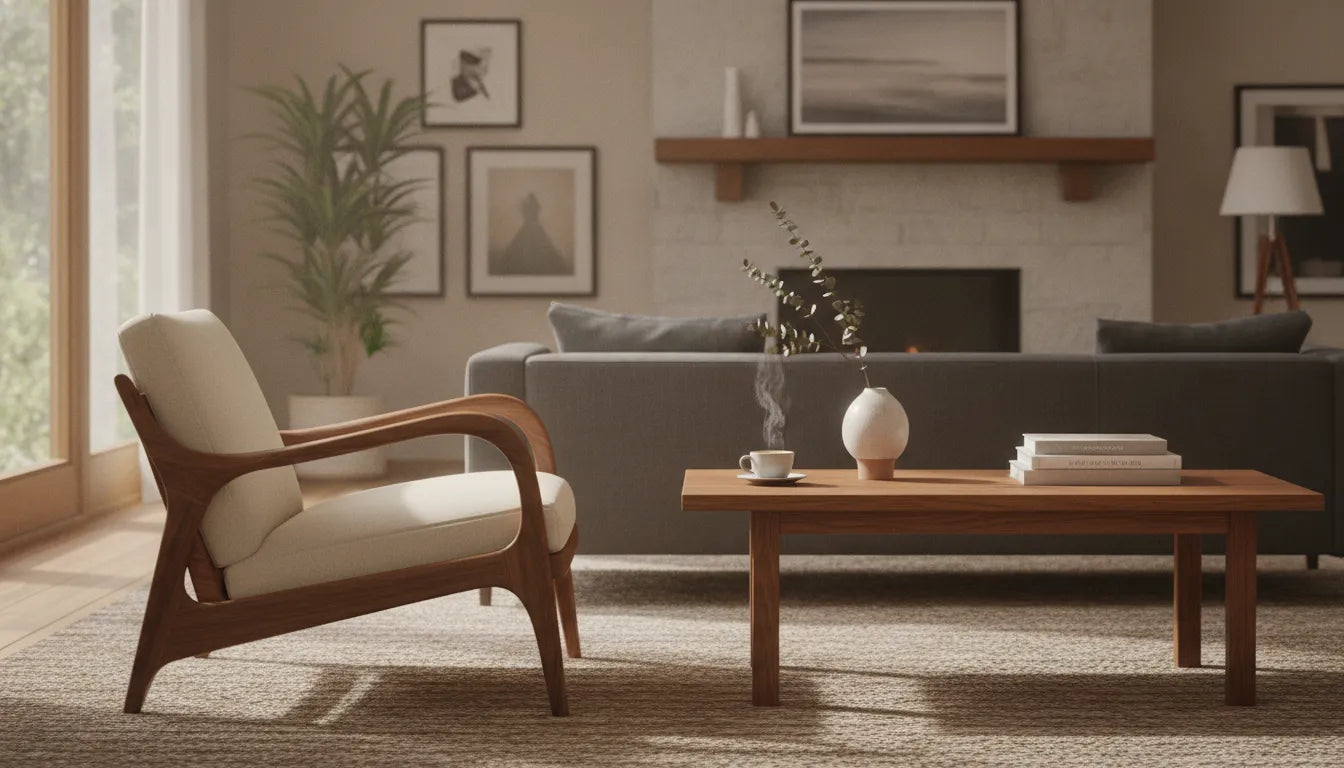

Furniture prices are easier to judge when you look beyond the checkout total. With solid walnut, you are paying not only for a recognizable natural material, but also for usable lumber, careful selection, skilled construction, finishing, and a design you may live with for many years.
So, is solid walnut furniture worth the price? It can be, if you value authentic grain, thoughtful construction, repairability, and long ownership more than the lowest upfront cost. It is not automatically the right choice for every budget, room, or timeline.
The honest answer depends on what the piece must do and how long you expect to keep it. A simple cost-per-year comparison can clarify the trade-off, while details such as joinery and finish help explain why two walnut-look pieces may differ substantially. Start with the material and labor behind the price, then use our solid walnut furniture guide as a practical reference.
The price reflects more than the name of the wood. With a well-made solid walnut piece, you are paying for the usable material, the work required to prepare it, the construction decisions that hold it together, and the design that determines how it lives in your home. Those factors help explain why is solid walnut furniture worth the price is best answered by looking closely at what is actually being made.
Walnut is valued for its natural color and grain, which can range from relatively straight to visibly figured. Heartwood may show deep brown alongside lighter brown, reddish, or purple tones. That variation is part of the appeal, but it also means a maker must select and arrange boards thoughtfully when a surface needs a coherent appearance. Milling and drying require skill as well, since poorly prepared lumber can warp. The amount of wood that remains suitable after defects, milling, and grain matching also matters. Current lumber prices vary, so a responsible comparison should focus on material quality and yield rather than treating an unverified price per board foot as universal.
Solid wood does not become durable furniture simply by being cut into panels. A craftsperson must shape components accurately, account for how wood moves, and create connections suited to the piece. Traditional mortise-and-tenon joinery is one construction method associated with Gingko's design approach, although the exact materials and joinery should be confirmed on each product. Finishing adds another layer of work. It protects and presents the grain while requiring careful preparation for an even, considered surface.
Design contributes to the cost, too. Clean lines and simple forms can look effortless, but proportion, balance, and functional details require deliberate decisions. Gingko treats walnut's natural grain as part of the design rather than merely applying a walnut-colored finish. The brand's direct-to-consumer model is designed in California, built in Asia, and centered on traditional craftsmanship. That context helps explain the value proposition without suggesting that every product has identical construction or that a higher price guarantees a particular lifespan.
Before paying more, inspect the specific piece. A practical checklist includes:
In other words, the premium is most defensible when it buys qualities you can identify and value: authentic material, careful construction, useful design, and a piece you expect to keep. It is not automatically justified by the word "walnut" alone.
Whether is solid walnut furniture worth the price has a useful answer depends less on the word "solid" than on how you plan to live with the piece. For a living room table, media console, or chair that will be used every day for years, the premium may make sense when you value natural material, thoughtful construction, and a design you will still want in the room later. For temporary furnishing, frequent moves, or a tightly constrained budget, a different material may be the more responsible choice.
Start with the use case. High-contact furniture benefits from a substantial material and construction approach, but solid walnut is not maintenance-free or indestructible. Wood responds to its environment: humidity can make it swell, while dry air can make it shrink. A suitable finish slows that movement without stopping it, so placement, care, and sound construction remain part of the value equation. The USDA Forest Service lists black walnut at a Janka hardness of 1,010, a useful indication that it is a durable hardwood, not a promise that a surface cannot dent or scratch.
The value is also visual. Walnut's grain and natural color variation are part of the design rather than a printed surface meant only to imitate wood. That character can give a simple, well-proportioned piece presence without relying on a passing trend. Gingko's approach centers on functional contemporary design, traditional craftsmanship, and solid walnut, with design led in California and production built in Asia. Product-specific materials and joinery should still be checked before you buy. For a broader checklist, see this solid walnut furniture guide.
The most honest test is to compare the full ownership picture, not just the checkout total: intended years of use, care requirements, construction details, and whether you genuinely like the piece. Solid walnut can be a strong everyday choice, but only when those factors align with your home and priorities.
The material choice affects more than the surface you see on day one. Solid walnut carries natural grain through the piece, so its color and figuring become part of the furniture's character rather than a printed or applied effect. That does not make veneer or particleboard inherently wrong. A well-made veneer piece can deliver a convincing walnut appearance and useful stability, while an engineered-core piece may suit a temporary room, a tight budget, or a design that does not need to be refinished. The better question is whether the material matches how you plan to live with the furniture.
When asking whether is solid walnut furniture worth the price, compare construction, intended use, and ownership horizon instead of judging by the label alone. Look at the core, edge treatment, joinery, finish, and the manufacturer's product specifications. Gingko's design philosophy treats walnut's natural grain as part of the design, and its brand emphasizes lasting materials, traditional craftsmanship, and functional contemporary design. Those priorities may matter to a buyer who wants the material itself to remain visible and relevant over time, but they should not be treated as a promise that every product has identical construction details.
| Material | Material expression | Stability and repair considerations | Design flexibility | Best use case |
|---|---|---|---|---|
| Solid walnut | Shows the wood's natural grain, color variation, and depth throughout the main components. | Wood can respond to humidity by expanding and contracting, so good design must allow movement across the grain. Construction and finish quality matter. Depending on the product and finish, solid components may offer more scope for future repair or refinishing than a thin surface. | Supports substantial forms, shaped edges, expressive grain matching, and designs intended to age with the room. | Long-term ownership when authentic material, visible craftsmanship, and enduring design are central priorities. |
| Wood veneer | Uses a real wood surface over a different core, allowing walnut's appearance without making every part solid walnut. | Quality depends on the core, veneer thickness, bonding, edge details, and protection. High-quality veneer can offer good stability, but deep sanding or damage to the surface may have different repair limits than solid wood. | Can create broad, carefully matched grain patterns and lighter forms while using solid wood selectively where it adds value. | Design-conscious furnishing when the walnut look matters and the product's construction meets the demands of the room. |
| Particleboard or engineered core | Provides a consistent base for veneer, laminate, or another applied finish rather than exposing walnut through the piece. | Performance varies with the board, edge protection, hardware, moisture exposure, and assembly. Repairs may be more limited when fastener holes, swelling, or surface damage affect the core. | Useful for efficient shapes, coordinated finishes, and applications where weight, cost, or replaceability outweighs exposed solid-wood character. | Shorter-term furnishing, rental spaces, secondary rooms, or carefully chosen designs where the core is appropriate for the use. |
There is also a practical distinction between material value and maintenance expectations. Solid wood is not immune to movement: a Purdue Extension guide explains that wood gains moisture and swells in humid air, loses moisture and shrinks in dry air, and that finishes generally slow rather than stop this process. Furniture therefore needs construction that allows movement across the grain. Veneer and engineered-core furniture can reduce or redirect some of those concerns, but they still require product-appropriate care and protection from unsuitable moisture.
Before paying more, ask what you will actually notice and use. If natural walnut character, traditional joinery, repair potential, and a piece's presence in a primary living space are important, solid walnut may justify the added investment. If the furniture is temporary or the surface appearance is your main priority, a well-specified veneer or engineered-core option may be the more rational choice. Compare the actual product details, not just the material name, and use this solid walnut furniture guide to examine the construction questions more closely.
Related products

Most dining chairs ask you to sit up straight.
View product

Dinner shouldn't just taste good — it should feel good, too.
View productSolid walnut is only part of the durability conversation. The way a piece is assembled, finished, and cared for determines how well it handles ordinary movement, daily use, and the occasional repair. That is why two pieces made from the same species can offer very different value over time. A useful starting point is Gingko's solid walnut furniture guide, then look closely at the construction details for the specific product you are considering.
Traditional mortise-and-tenon joinery is a central construction method in Gingko's design philosophy. The method connects one component through a carefully fitted tenon into a matching mortise, creating a structural connection rather than relying only on surface fasteners. Gingko's knowledge base also references 26+ joints per piece as part of its craftsmanship story. That detail should be understood as a brand-level description, not a claim that every product has identical construction. Product pages remain the right place to verify the materials and joinery used in a particular design.
Good joinery also accounts for the fact that wood is not static. According to Purdue University's furniture-wood guidance, wood gains moisture and swells in humid air, then loses moisture and shrinks in dry air. Furniture must allow solid wood to expand and contract across the grain, or seasonal movement can put stress on joints and panels. A finish may slow that movement, but it generally cannot stop it. Construction that respects this behavior can support a longer useful life than construction that treats wood like an inert sheet material.
A finish helps protect the surface from everyday contact and makes routine care more manageable, while also shaping how walnut's natural grain and color appear. It does not make a piece immune to scratches, dents, moisture, sunlight, or neglect. Keep solid walnut furniture away from prolonged direct sun when possible, wipe spills promptly, and follow the care guidance supplied for the product. Avoid assuming that a household cleaner, polish, or refinishing method is appropriate simply because it works on another wood or finish.
Repairability is another part of the lifespan math. A well-documented solid-wood piece may offer more options for addressing a worn surface or a loose connection than a product that cannot be repaired in the same way. That does not mean every solid walnut item can be sanded, refinished, or rebuilt without limits. It means construction and finish deserve as much attention as the wood species when you are deciding whether the higher upfront cost fits your ownership plans.
A higher purchase price becomes easier to evaluate when you separate the upfront cost from the time you expect to use the piece. This is not a promise of savings or a prediction of a fixed lifespan. It is a transparent way to test whether the furniture fits your plans, budget, and expectations.
Finally, weigh the number alongside fit, construction, finish, daily function, and design relevance. Cost per year can clarify the trade-off, but it cannot decide whether the grain, proportions, or care requirements suit your home. For a broader framework, review this how to choose lasting furniture guide before making the comparison.
Solid walnut can be a thoughtful long-term purchase, but it is not automatically the best fit for every room or budget. The right question is not whether walnut is objectively better. It is whether its material character, construction, and expected service life match the way you will use the piece.
A lower upfront cost may be more sensible when the furniture has a short assignment. If you are furnishing a temporary apartment, staging a home, setting up a first rental, or expecting to move soon, portability and cash flow may matter more than owning a piece for many years. The same is true when a room is still evolving. Buying a simpler option now can leave more flexibility for a future home with different proportions and needs.
None of these choices makes another material inferior. Veneer, engineered wood, painted wood, and other constructions can serve practical purposes when their specifications suit the setting. Compare the core material, edge treatment, joinery, finish, care requirements, and intended use rather than judging by the label alone.
Before deciding, write down how long you realistically expect to keep the piece, how often it will move, what wear it will face, and which qualities you care about most. If the answers point toward flexibility or short-term value, choose accordingly. If they point toward natural walnut, enduring design, and long ownership, the premium may deserve a closer look. Our how to choose lasting furniture guide can help you evaluate those trade-offs without treating one material as right for everyone.
Solid walnut is a thoughtful choice when you want the material, construction, and design to remain part of your home for many years. It is less compelling when your priority is the lowest upfront cost or a temporary solution. The honest answer is not that every buyer needs solid walnut. It is that the higher price makes the most sense when you will use the piece often and appreciate what you are paying for.
Start with the product itself, not the label. Review the listed material, joinery, finish, dimensions, and care guidance. Solid walnut should be described clearly, and construction details should be specific enough to help you understand how the piece is made. Product pages can differ, so do not assume that every chair, table, or cabinet has identical construction simply because it comes from the same brand.
Gingko Furniture designs its pieces in California and builds them in Asia. The brand focuses on handcrafted solid walnut furniture with mid-century modern and contemporary influences, traditional craftsmanship, clean lines, and functional beauty. That positioning is useful context, but the best decision still depends on the individual piece and how it fits your room, budget, and plans.
If you are ready to compare pieces, browse solid walnut accent chairs or review how to buy from Gingko before making a decision.
The price reflects more than the species of wood. You may be paying for usable walnut lumber, grain selection, skilled shaping, joinery, sanding, finishing, design development, and the labor required to make a stable piece. The exact balance depends on the product, so compare construction details rather than assuming every walnut item offers the same value.
Not automatically. Solid walnut offers natural material throughout the relevant components and may be easier to repair or refinish, while a well-made veneer piece can use beautiful walnut efficiently and remain the right choice for some designs and budgets. Look at the core, veneer quality, edge treatment, joinery, finish, and intended use. The better choice is the one that fits your priorities.
Well-made solid wood furniture can serve for decades, but no responsible guide should promise one lifespan for every product or household. Care, humidity, sunlight, load, moving, joinery, and finish all affect useful life. Treat broad lifespan ranges as planning examples, then check the specific product's care and construction information.
Divide the total purchase cost by the number of years you reasonably expect to use the piece. For a more honest comparison, include delivery, routine care, likely repairs, and the replacement costs of alternatives. Label every price and lifespan input as an estimate unless it comes from a current, verified source.
No. It can be worth the price when you value natural grain, lasting design, quality construction, and long ownership. It may not be the best fit for temporary furnishing, frequent moves, or a situation where the lowest upfront cost matters most. A transparent decision weighs both the benefits and the trade-offs.
The value of solid walnut furniture depends on what you want from the piece and how long you expect to live with it. Compare the material, joinery, finish, dimensions, care requirements, and total ownership assumptions before you buy. If those details align with your priorities, solid walnut can be a considered investment in everyday function and enduring design.
When you are ready to explore the options, learn how to buy from Gingko and review the current product information before choosing the piece that fits your home.